

Work with your existing tools
We have real world experience connecting to hundreds of the most popular apps and tools using APIs and integrations, that once set up, enable you to work with the tools and services you love.
Whether you need to automate workflows, connect your email list, build a community or embed products from your ecommerce store, our experience with integrations has you covered so you can focus on what you do best and let us take the pain out of the setup process.

If you would like some assistance with .NET MAUI | Azure | Azure DevOps Services | Blazor Development then please get in touch, we would be glad to help.
Zapier
As an example, Zapier enables more than 1,000 external services to connect and collaborate, focusing on a zero code approach.
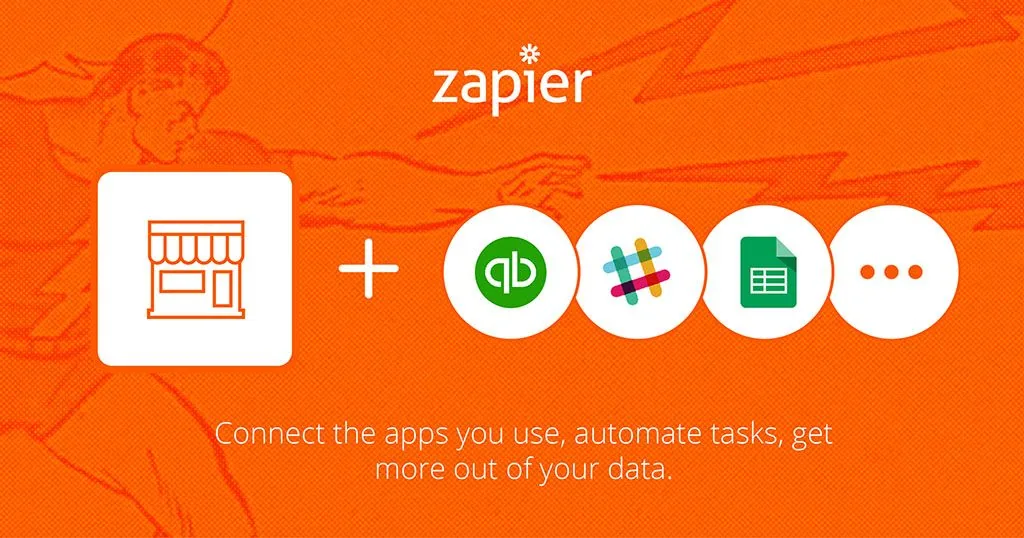
Zapier sets up automations with Triggers and Actions, which allows you to create and customise a wide range of connected applications.
Example: When someone new subscribes to a newsletter on your website (Trigger) then the contact information is automatically pushed into MailChimp (Action).
Where integration delivers the biggest wins
Not all integrations are worth the same to a business. In our experience the projects that pay for themselves fastest share a pattern: they remove a piece of manual copying between two systems that happens many times a day. Some familiar examples:
- Order flow: an online store, a warehouse or stock system, a courier and an accounts package all need to know about the same order. Connect them and the order flows through untouched; leave them separate and someone rekeys it at every step. Our warehouse management work for an online retailer is a good picture of what this looks like in practice.
- Payments and reconciliation: matching payments to invoices automatically, so the books balance themselves and exceptions are the only thing a human ever needs to look at.
- Customer data: keeping the CRM, the mailing list and the support desk in agreement, so a change of email address made once is made everywhere.
- Reporting: pulling data from several systems into one live dashboard, replacing the monthly spreadsheet ritual.
The common thread is that the value comes from the workflow, not the technology. That is why we always start with the process you want to improve and work back to the tools, whether the answer turns out to be an off-the-shelf connector or the kind of tailored work we describe in our software integration case study.
Custom integrations
Many third parties offer APIs (Application Programming Interfaces) to create, manage and retrieve content with ease.
Stripe payments, for example, offer the ability to create webhooks to manage successful payments and manage payment notifications for your project's financial transactions.

What a good integration looks like
Wiring two systems together is easy on a demo; the difference between a quick hack and an integration you can trust for years comes down to a handful of habits we apply every time:
- API-first thinking — treat the third party's API contract as the source of truth. Read the documentation for rate limits, pagination and versioning before writing a line of code, and build against a sandbox or test account rather than live data.
- Webhooks over polling — where a service can push events to you (as Stripe does for payments), prefer that to repeatedly asking "has anything changed?". Always verify webhook signatures, respond quickly, and do the real work in the background so a slow handler never causes the sender to give up.
- Design for failure — external services will occasionally be slow, down or return errors. Retries with backoff, timeouts and idempotent handlers (so replaying the same event twice does no harm) turn those wobbles into non-events instead of support tickets.
- Keep secrets out of code — API keys and webhook secrets belong in a secrets store such as Azure Key Vault, never in source control or configuration files, and should be rotated without a redeploy.
- Monitor the seams — log every outbound call and inbound event with enough context to answer "what happened to order 1234?" months later, and alert when failure rates rise. Integrations fail quietly; good telemetry makes them fail loudly.
None of this needs to be heavyweight. For a small business connecting a payment provider and an email platform, it might be a few well-placed queues and a dashboard. The point is that reliability is designed in, not bolted on after the first missed payment notification.
We can create custom solutions or work with your developers of almost any level.
Integrations in 2026: what has changed
This article dates from 2020, and the direction of travel has only accelerated. The average business now runs on far more connected services, and the integration platforms have matured to match: Zapier connects thousands of apps rather than a thousand, and in the Microsoft world Power Automate and Azure Logic Apps offer the same trigger-and-action model with first-class connectors into Microsoft 365, Dynamics and Azure. For straightforward "when this happens, do that" automation, a no-code platform is very often the right answer, and we will happily say so.
Custom integration work has changed too. AI-assisted development tools are genuinely good at the tedious parts — generating typed clients from an OpenAPI specification, drafting webhook handlers, mapping one payload shape to another — which means more of the engineering effort goes where it belongs: the failure handling, security and monitoring described above. Those fundamentals have not changed at all; if anything, with AI agents now calling APIs on businesses' behalf, well-documented, resilient integration points matter more than ever.
Our advice as of 2026: use an integration platform where an off-the-shelf connector genuinely fits, and invest in custom integration development where the workflow is core to your business — usually running on Azure, where queues, functions and Key Vault make the reliable version the easy version.
At Assemblysoft we specialise in Custom Software Development tailored to your requirements. We can onboard and add value to your business rapidly. We are an experienced Full-stack development team able to provide specific technical expertise or manage your project requirements end to end. We specialise in the Microsoft cloud and .NET Solutions and Services. Our developers are Microsoft Certified. We have real-world experience developing .NET applications and Azure Services for a large array of business domains. If you would like some assistance with Azure | Azure DevOps Services | Blazor Development | .NET MAUI Development or in need of custom software development, from an experienced development team in the United Kingdom, then please get in touch, we would love to add immediate value to your business.

Assemblysoft - Your Safe Pair of Hands